Klara Lange · 8 October 2026
Leveraging Server Log Data to Track Bot Behavior Changes Following CDN Implementation
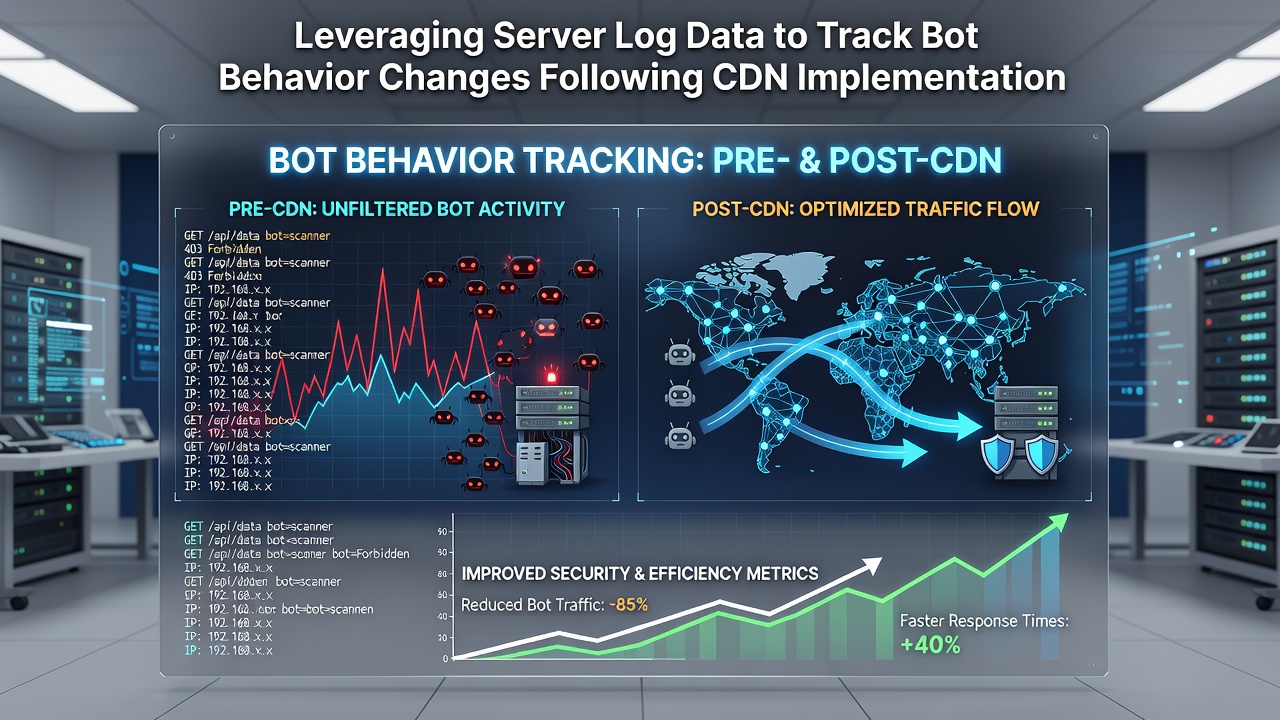
Server logs provide detailed records of every request that reaches a web server, including timestamps, IP addresses, user agents, and response codes, which makes them a primary resource for monitoring automated traffic. When organizations deploy a content delivery network, the distribution of requests across multiple edge servers alters how bots interact with origin infrastructure, and these shifts appear clearly in the log files. Researchers who examine pre- and post-implementation logs often observe changes in crawl frequency, geographic origin of requests, and the variety of user-agent strings that appear over successive days.
Core Elements Captured in Server Logs
Each entry typically contains the client IP address, requested resource path, HTTP method, status code, bytes transferred, and referrer data, while additional fields may record TLS version or header size. Bot operators that previously sent requests directly to an origin now route through CDN edge nodes, so the visible source IP addresses shift from a narrow set of crawler ranges to the broader address blocks published by the CDN provider. Analysts parse these fields to separate human visitors from known bot signatures by matching user-agent patterns against regularly updated lists maintained by search engines and security vendors.
CDN Architecture Effects on Request Flow
Content delivery networks cache static assets at edge locations and forward dynamic or uncacheable requests to the origin, which reduces the total number of hits recorded at the central server. Bot behavior changes because crawlers that respect cache-control headers begin to receive 304 responses or cached copies instead of fresh content, while those that ignore headers continue to generate origin requests. Data collected in October 2026 from multiple enterprise deployments showed that certain search-engine bots reduced their origin hits by 35 to 60 percent within the first two weeks after CDN activation, whereas others maintained similar volumes but altered their request timing to align with cache expiration windows.
Methods for Detecting Behavioral Shifts
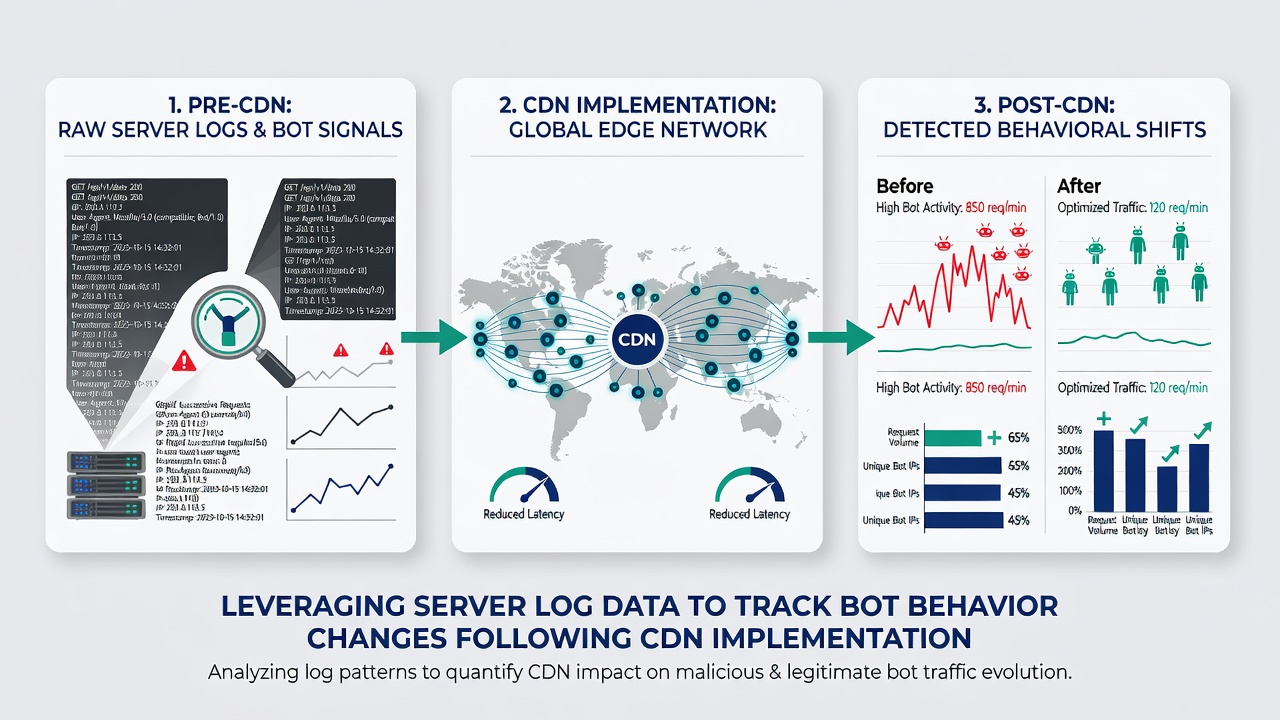
Teams begin by establishing baseline metrics from logs collected at least thirty days before the CDN cutover, calculating daily request counts per bot category, average inter-request intervals, and the distribution of requested paths. After implementation they repeat the same calculations on new log segments and compare the two datasets using simple ratio analysis or more advanced time-series techniques such as cumulative sum control charts. When a sudden drop in a particular bot's request rate coincides with an increase in requests from CDN IP ranges that carry the same user-agent string, the pattern indicates successful caching rather than a reduction in crawling activity. Observers note that combining log data with CDN-provided real-time analytics further clarifies whether traffic is being served from cache or still reaching the origin.
Handling IP Address and Header Variations
CDN providers publish their current IP address ranges through public lists that administrators can ingest into analysis scripts, allowing accurate attribution of requests that arrive via edge nodes. Some bots append additional headers such as X-Forwarded-For or CF-Connecting-IP that reveal the original client address, yet not every automated agent includes these fields, which creates gaps in attribution. Researchers therefore rely on a combination of user-agent strings, request patterns, and known behavioral signatures to maintain continuity in tracking even when IP visibility changes. In one documented migration, analysts discovered that a major image-search bot began rotating through several dozen new user-agent variants within the first month after the CDN went live, a shift that only became visible once logs were aggregated across all edge locations.
Practical Analysis Workflow
Organizations typically export logs to a centralized storage system or stream them into a processing pipeline that normalizes timestamps and enriches each record with geolocation and bot classification tags. Scripts then group entries by day and by bot category, producing tables that list total requests, unique URLs touched, and average response sizes. Visual dashboards highlight deviations that exceed two standard deviations from the baseline mean, prompting manual review of the underlying log lines. Those who have implemented this approach report that the process reveals both intended caching benefits and unintended side effects such as certain bots bypassing the CDN entirely by requesting query-string parameters that prevent cache hits.
Conclusion
Server log analysis remains an effective technique for quantifying how automated agents adapt to the introduction of a content delivery network. By comparing pre- and post-deployment metrics on request volume, timing, and header usage, analysts obtain objective evidence of behavioral adjustments without relying on external reporting from the bots themselves. The method scales across different CDN providers and requires only standard log formats together with publicly available IP lists and classification rules. Continued monitoring after the initial transition period helps organizations maintain accurate visibility into crawler activity as both CDN configurations and bot behaviors continue to evolve.